|

|
|
|
Colorado State University (CSU) hurricane researchers are predicting a somewhat below-average Atlantic hurricane season in their initial 2026 forecast. CSU’s Tropical Cyclones, Radar, Atmospheric Modeling, and Software Team within the Department of Atmospheric Science cites the forecast of a robust El Niño as a primary factor for their prediction of 13 named storms, of which they anticipate six to become hurricanes and two to become major hurricanes (Category 3+ on the Saffir-Simpson Hurricane Wind Scale). These numbers are slightly below the seasonal average of 14, seven, and three, respectively.
Prepare now: update your family plan and evacuation plan, check your radios, prepare antennas, know your local and regional net frequencies, especially the Hurricane Watch Net frequency (14.325 MHz) and your ARES net frequencies and plans.
Jackson, Mississippi—Members of the Jackson Amateur Radio Club and Central Mississippi Amateur Radio Association provided communications for the annual Natchez Trace Century Ride
on May 2. There were nearly 900 cyclists in this event.
Hams were placed at all rest stops and turnaround points, reporting important information on cyclists who were having difficulties or had broken down.
They also gave updates as to where cyclists were on the course.
Ridgeland Parks and Recreation, sponsor of the event, expressed appreciation for the radio amateurs who provided an element of safety for the riders.
— James Armstrong, AK5J, Jackson, Mississippi
|
|
|
|
Southern California Hams Handle "Tax Day" Earthquake Exercise With Confidence |
|
On April 15, 2026 ("Tax Day"), more than 100 southern California hams mobilized to support public safety and medical functions during an Earthquake Full Scale Exercise (FSE) and Medical Response and Surge Exercise (MRSE) in San Diego County, California, the fifth-most populated county in the United States.
Hams deployed to over 40 locations to provide communications support to hospitals, law enforcement, military bases, city and county emergency operations centers (EOCs), tribal communities, and evacuation shelters for the magnitude 6.9 earthquake exercise scenario.
Damage was simulated along the busy north-south Interstate 5 corridor, in downtown San Diego, and in northern Mexico, knocking out key bridges, other infrastructure, and the San Diego International Airport.
The exercise was planned by the California and San Diego County Offices of Emergency Services (OES).
Amateur radio organizations participating included the San Diego Amateur Radio Emergency Service (ARES), San Diego Sheriff's Office Auxiliary Communications Service (ACS), American Red Cross Disaster Support Team (DST), and Community Emergency Response Team (CERT) groups such as the Poway Auxiliary Communication Team (PACT).
Radio amateurs were stretched thin to cover 40 locations, from hospital trauma centers in beach cities along the populated coast to rural mountain towns in the backcountry.
With simultaneous activation of several amateur radio organizations, hams with membership in more than one group had to decide which organization to support, resulting in less-than-full staffing at some locations.
Consequently, hams had to step up to fill roles that were vacant due to these challenges.
Marty Latterich, AF5T, District Emergency Coordinator (DEC) for Northern San Diego County, said, "I’m incredibly proud of our team! … When infrastructure fails, our ARES volunteers step in immediately using both voice and Winlink digital messaging to keep hospitals and emergency managers connected.” Latterich concluded, “It’s not just about technology—it’s about making sure critical information gets through when lives depend on it.”
ARES participation was praised universally by county government representatives.
Karrah Cardone, the county public health planner for the medical component of the FSE, commented "We love our ARES!" Paula Murray, a county exercise evaluator, reflected during the outbrief, "I was impressed by how seriously everyone [in ARES] took their roles … And, it was great having ARES co-located with county medical staff."
The FSE included a regional HF net with check-ins from other counties and states across the southwestern United States, the most distant check-in being from Nye County, Nevada, 300 miles away from San Diego.
Hams in the ARRL Los Angeles (LAX) Section were solid copy on HF.
The regional near vertical incidence skywave (NVIS) HF net spanned three bands (75, 60, and 40 meters), demonstrating to served agencies that hams can communicate outside the affected area during an exercise or actual event.
Hams handled more than 500 formal messages using Winlink and enjoyed the new longer tactical call signs allowed in the Winlink system protocols.
With up to 24 characters allowed now in Winlink tactical call signs, there was less need to abbreviate hospital names and locations.
With fewer abbreviations, it was easier for non-hams to read Form 309 communications logs to understand the flow of message traffic.
In addition to ham check-ins, several stations equipped with SHAred RESources (SHARES) High Frequency (HF) radio equipment practiced using their non-ham SHARES call signs to pass traffic between government stations on government frequencies.
SHARES stations are located in federal, state, and industry organizations in all 50 states and are often placed in emergency operations centers (EOCs) next to amateur station equipment.
Hams understand HF propagation and can explain to non-hams at government centers how to use the SHARES equipment and non-ham call signs. The Chief Radio Officer (CRO) of San Diego Sheriff's ACS, Mike Downs, AI6XQ, remarked, "ACS communications using SHARES and amateur bands were smooth between the county EOC and other local, state, and federal entities in the Operational Area.
Years of training paid off during this Full Scale Exercise." — ARRL San Diego Section Assistant Section Manager Rob Freeburn, K6RJF
|
|
Mississippi Section SET: “Operation Undead” |
|
An ARRL Mississippi Section ARES Simulated Emergency Test (SET), code-named “Operation Undead,” took place on Saturday, March 14, running for twelve hours from 7:00 AM to 7:00 PM. The scenario was a severe disruption of commercial communications infrastructure coupled with a localized biological threat—a novel pathogen outbreak mimicking an “undead” scenario requiring specialized public health coordination for quarantine and resource allocation.
The primary mission for Mississippi ARES was to coordinate amateur radio operators supporting overflow and emergency communications for public safety, public service, and state and local government entities, focusing specifically on the public health sector.
ARES members were instructed to deploy from home stations, mobile units, and portable setups, often strategically positioned at emergency operations centers (EOCs) and public health agency locations.
The purpose of the drill was to evaluate emergency preparedness strengths and weaknesses, and demonstrate ARES capabilities to served agencies and the public.
After-action summaries will show operational insights and provide guidance for future preparation efforts.
All participants have been requested to submit online reports post-event, including Emergency Coordinator and Net Manager reports, as well as narrative After-Action Reports (AARs). Additionally, preparations for the 2026 SET included Mikah Crochet, K5WZL, EC for Pearl River County, coordinating with Mississippi State Guard communications assets, confirming their active participation and necessitating further meetings to ensure coordination and interoperability.
— ARRL Mississippi Section Emergency Coordinator Robert Hayes, KC5IMN
|
|
Pennsylvania ARES/RACES Group Receives SKYWARN Basic Training |
|
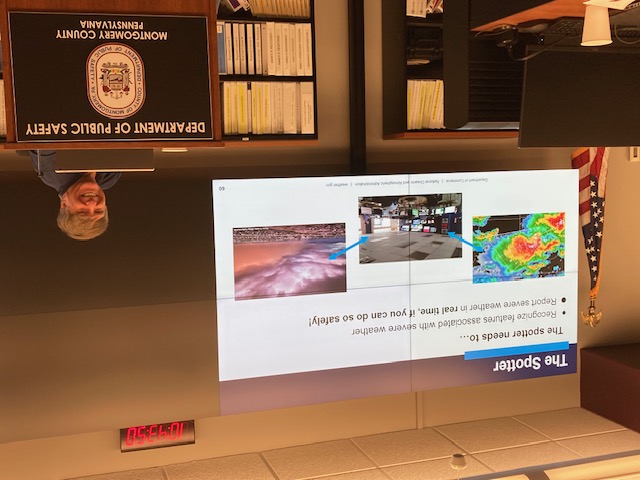
At its regular meeting on May 9, members of Montgomery County (ARRL Eastern Pennsylvania Section) ARES/RACES (MCAR) updated or received their initial Basic Course in SKYWARN training.
Longtime “storm chaser” and MCAR member Lou Ruh, WX3I, presented the 2-hour course. Ruh is a SKYWARN trainer as well as an on-the-ground after event analyst, utilized by the National Weather Service, (NWS). MCAR typically schedules Basic and Advanced SKYWARN training sessions in alternating years.
Many MCAR members have taken the courses multiple times and, when conditions have warranted it, submitted SKYWARN reports to the local NWS office in New Jersey.
Ruh emphasized the value of “on the ground” reports to the NWS from trained SKYWARN observers since the beam of NWS radars angle upward and may not fully capture what is actually happening on the ground.
The SKYWARN training was presented at the Montgomery County (PA) Emergency Operations Center in Eagleville.
— MCAR Public Information Officer Robert Alan Griffiths, NE3I
|
 |
|
|
SKYWARN trainer Lou Ruh, WX3I, presenting SKYWARN Basic Training to MCAR members at the Montgomery County (PA) EOC. | | | |
|
Assets: The Florida Statewide Amateur Radio Network—SARnet |
|
The Statewide Amateur Radio Network (SARnet) is a system of linked UHF voice repeaters that serves the State of Florida.
The repeaters are maintained/operated by their local trustees.
The network that connects them together does not interfere with the local use of the repeaters.
The repeaters were specifically chosen in part because voice traffic is light, which helps ensure that long conversations are rare since any SARnet traffic brings up all of the repeaters on the network.
Statewide connectivity is achieved without the use of the internet or any commercial telecommunications services.
The State of Florida Department of Transportation (FDOT) has continually investigated new IP technologies for use in improving its own voice radio network and to meet its mandate to provide interoperable communications with other state agencies and public safety entities.
Instead of using their live voice radio network as an ongoing test bed for these new IP technologies, the FDOT has partnered with the amateur radio community to use their radio systems.
The benefit for FDOT is that its people gain valuable knowledge about how to install, operate, troubleshoot, expand, upgrade, and maintain a sophisticated IP radio network.
With SARnet, the FDOT can conduct its research without jeopardizing its live voice radio system and creating potentially unsafe and counterproductive conditions for the FDOT personnel who work on the state's highways every day.
In exchange for supporting this research, the amateur radio community can talk across the state using the same amateur radio equipment they use every day.
The fact that the FDOT network that connects these amateur radio repeaters in a stand alone carrier class microwave network means that SARnet is much more likely to remain operational during a severe weather event like a hurricane that might cause disruptions to the internet, cellular telephone and other commercial communication services.
SARnet is a network of amateur repeaters owned mostly by non-emcomm affiliated hams.
So it is not just for emergency communications.
That being said, the creators of the network behind SARnet are active in public safety communications, both commercial and amateur, and they have an understanding of what SARnet can do for emergency communications in the State of Florida.
|

|
|
|
Two major emcomm and ARES experience/training events are coming up: The ARRL June VHF Contest (June 13-15), and, of course, ARRL Field Day, which will be held June 27-28.
The ARRL New England Division Convention
is set for August 13-16 in Marlborough, Massachusetts.
The program schedule has not yet been set, but ARES members can expect lively forums on emcomm and ARES topics conducted by local and national subject matter experts.
Hope to see readers of The ARES Letter there!
|

|
|
|
The Amateur Radio Emergency Service® (ARES) consists of licensed amateurs who have voluntarily registered their qualifications and equipment with their local ARES leadership, for communications duty in the public service when disaster strikes.
Every licensed amateur, regardless of membership in ARRL or any other local or national organization is eligible to apply for membership in ARES.
Training may be required or desired to participate fully in ARES.
Please inquire at the local level for specific information.
Because ARES is an amateur radio program, only licensed radio amateurs are eligible for membership.
The possession of emergency-powered equipment is desirable, but is not a requirement for membership.
How to Get Involved in ARES: Fill out the
ARES Registration form
and submit it to your local Emergency Coordinator.
|
|
ARES® is a program of ARRL The National Association for Amateur Radio®. No other organization works harder than ARRL to promote and protect amateur radio! ARRL members enjoy many benefits and services including digital magazines, e-newsletters, online learning (learn.arrl.org), and technical support.
Membership also supports programs for radio clubs, on-air contests, Logbook of The World®, ARRL Field Day, and the all-volunteer ARRL Field Organization.
Join ARRL or renew today!
www.arrl.org/join
The ARES Letter is free of charge to ARRL members.
Subscribe:
www.arrl.org/subscribe
Find ARRL on Facebook, Instagram, YouTube, X (@arrl and @arrl_ares), and Threads
ARRL Store:
www.arrl.org/shop
Support programs not funded by member dues at
www.arrl.org/donate
Contact us to advertise in this newsletter (space subject to availability):
ads@arrl.org
|
|
The ARES Letter is published on the third Wednesday of each month. ARRL members may subscribe at no cost or unsubscribe by editing their Member Data Page at
www.arrl.org/opt-in-out.
Copyright © 2026 American Radio Relay League, Incorporated. Use and distribution of this publication, or any portion thereof, is permitted for non-commercial or educational purposes, with attribution. All other purposes require written permission.
|
|
| |
| | | |